
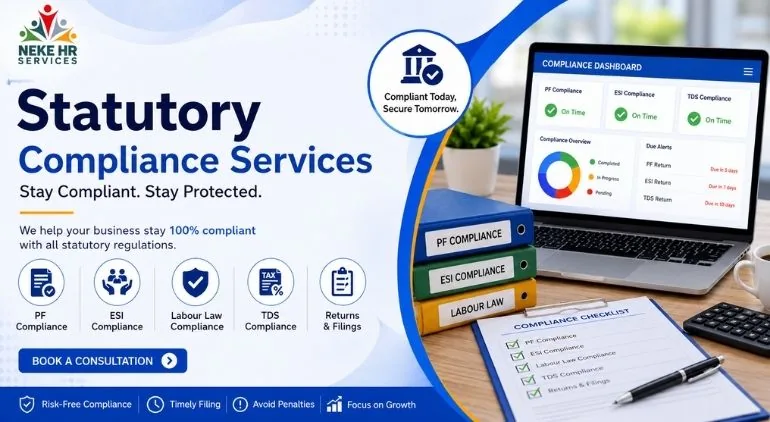
Most businesses do not lose money to statutory non-compliance in one dramatic incident. It happens quietly, a missed PF deposit here, an unregistered contract worker there, a professional tax filing that slipped by a month, until an inspection or an employee complaint brings the whole picture into view at once. By then, what could have been a routine correction has become interest, damages, and in some cases prosecution. Statutory compliance exists precisely to prevent that build-up, and understanding how it works is the first step towards avoiding the penalties it is designed to guard against.
What Statutory Compliance Actually Covers?
Statutory compliance refers to the legal framework an employer must operate within concerning wages, social security, working conditions, and workplace safety. In India, this has recently undergone its biggest overhaul in decades. Four labour codes, the Code on Wages, the Industrial Relations Code, the Code on Social Security, and the Occupational Safety, Health and Working Conditions Code, came into force on 21 November 2025, consolidating twenty-nine older central laws into a single framework.
For employers in Tamil Nadu, this transition carries a particular wrinkle. As of mid-2026, several major industrial states, Tamil Nadu among them, have not yet finalised their state-level rules under the new codes, while states such as Gujarat, Karnataka, and Madhya Pradesh already have. In practice, this means Coimbatore businesses must continue complying with both the older legacy Acts and the new codes simultaneously until Tamil Nadu notifies its own rules, a transitional period that catches out employers who assume the old rulebook has already been retired.
Why the Definition of Wages Now Matters More?
One of the most consequential changes under the new codes concerns how wages are defined. Allowances that were traditionally excluded from wage calculations, such as house rent allowance and conveyance, are now capped at 50 per cent of total remuneration. Anything paid above that cap gets reclassified as wages for the purpose of calculating PF, ESI, and gratuity contributions. Businesses that have not reviewed their salary structures against this rule risk under-contributing without realising it, an error that surfaces only when the figures are checked against the new definition during an audit.
The Cost of Getting It Wrong
The financial penalties attached to non-compliance have grown sharper under the new framework, not softer. A first offence under the Code on Wages can attract a fine of up to ₹50,000, while a repeat offence within five years can mean imprisonment of up to three months alongside a fine reaching ₹1 lakh. Violations under the Industrial Relations Code can draw fines of up to ₹5 lakh. There is some relief built in for first-time, unintentional lapses, since a first offence is generally compoundable at 50 per cent of the maximum fine for fine-only violations, but repeat offences within five years lose that option entirely.
Gratuity obligations have also shifted meaningfully. Fixed-term employees now qualify for gratuity after just one year of continuous service rather than the previous five, and the overall gratuity ceiling has doubled from ₹10 lakh to ₹20 lakh. Businesses that still budget and calculate gratuity liability on the old thresholds are quietly under-provisioning for an obligation that has become considerably larger.
Contract Labour Is Where Liability Quietly Transfers
Principal employer liability is one of the areas businesses in Coimbatore’s manufacturing and engineering clusters consistently underestimate. Where a contractor fails to deposit PF or ESI contributions, or fails to pay wages, for workers deployed at a client’s premises, that liability does not stay with the contractor. It transfers to the principal employer, regardless of any indemnity clause written into the contract. An HR compliance in Coimbatore programme that only checks a contractor’s registration certificate at onboarding, without ongoing verification of monthly filings, is not actually managing this risk.
Compliance Management as an Ongoing Discipline
Inspections themselves have changed character. The older, largely manual inspection system is giving way to a data-driven, digital model, increasingly described as Inspector-cum-Facilitator inspections, where payroll data, filing history, and employee complaints are cross-referenced through analytics rather than relying solely on a physical site visit. This shift means gaps that once went unnoticed for years are now considerably more likely to surface quickly, which raises the practical value of treating compliance management as a continuous monthly discipline rather than an annual scramble before an audit.
Professional tax, a state-level levy that varies by state and is easy to overlook precisely because it operates outside the PF and ESI conversation, illustrates this well. Employers are required to register within thirty days of hiring, deduct the tax monthly, and deposit it on time, with late penalties typically ranging from 10 to 50 per cent of the amount due. It is a small line item individually, but one that accumulates quickly across a growing workforce if nobody owns the filing calendar.
Why This Matters Beyond the Fine Itself?
The direct financial penalty is rarely the most expensive part of non-compliance. A poor compliance record surfaces during due diligence for funding rounds, larger client contracts, and bank credit assessments, well beyond the immediate cost of the fine itself. For growing businesses trying to build credibility with investors or larger corporate clients, a clean statutory compliance record has become a genuine commercial asset rather than a purely defensive one.
Building Compliance Management Around Local Reality
Meeting these legal requirements consistently is less about knowing every provision of the new codes and more about having a system that tracks deadlines, wage definitions, and contractor filings without depending on any single person remembering all of it. For businesses operating out of Coimbatore, where the transition between old and new frameworks is still incomplete, that discipline matters more, not less. Neke HR Services supports growing businesses across Tamil Nadu with statutory compliance management that stays current with both the legacy rules still in force and the new codes taking shape around them.