
Small business owners in India carry a particular kind of pressure that larger organisations rarely understand from the inside.
You are simultaneously the decision-maker, the operator, the sales team, and often the person signing off on payroll at eleven o’clock on a Friday night. The idea of sitting down with a stack of compliance documents and working out exactly which laws apply to your establishment, which registrations you need, which returns are due by when, and what happens if you’ve missed something- it gets pushed to later. And later keeps moving.
The problem is that statutory compliance doesn’t pause while you’re busy running the business. Deadlines arrive regardless. Inspectors visit without prior notice. Penalties accumulate on obligations that were never on your radar. And the moment a compliance gap surfaces, through an inspection, a dispute, or an audit, the cost of addressing it reactively is almost always higher than the cost of staying on top of it would have been.
This piece is a practical, plain-language guide to the statutory compliance requirements that small businesses in India need to understand and manage. Not an exhaustive legal textbook, but a clear overview of what applies, why it matters, and where the common pressure points are.
What Statutory Compliance Actually Means for a Small Business
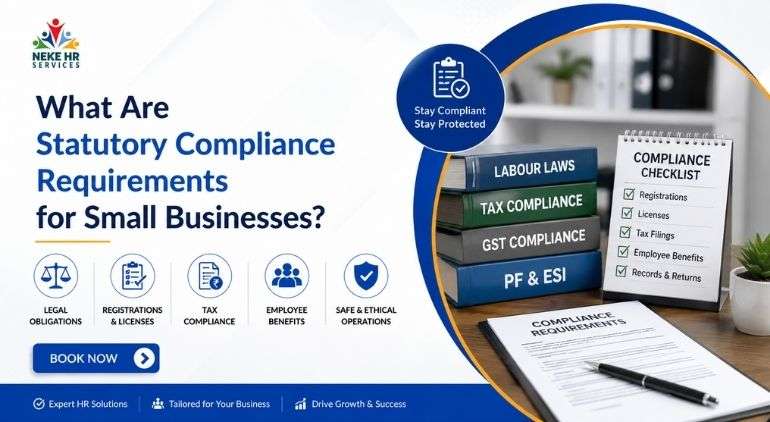
Statutory compliance refers to the legal obligations a business must fulfil under applicable central and state laws, covering how employees are paid, what deductions must be made and remitted, what working conditions must be maintained, what records must be kept, and what returns must be filed with government authorities.
The framework governing this in India draws from multiple pieces of legislation, some central, some state-specific, some applicable from the first employee, and some kicking in only once a threshold headcount is reached. Understanding which laws apply to your specific establishment is the essential starting point, because compliance is not a uniform exercise. A manufacturing unit with fifteen workers in Tamil Nadu has different obligations from a retail shop with eight staff in Maharashtra.
India has been consolidating its labour legislation into four labour codes: the Code on Wages, the Industrial Relations Code, the Code on Social Security, and the Occupational Safety, Health and Working Conditions Code, which are intended to simplify this landscape significantly. However, until state governments notify the rules under these codes, existing legislation continues to apply in most states. Navigating this transitional period requires current, local knowledge.
Registration Obligations, The Starting Point
Before a business employs anyone, certain registrations are required. Getting these right from the beginning establishes a clean compliance foundation. Trying to sort them out retrospectively, particularly after an inspection has flagged their absence, is considerably more complicated.
Shops and Establishments Registration
Every business operating on commercial premises- a shop, an office, or a service establishment- must register under the applicable state Shops and Establishments Act. In Tamil Nadu, this is the Tamil Nadu Shops and Establishments Act. Registration is typically required within thirty days of commencing operations and must be renewed periodically.
This registration governs working hours, rest intervals, weekly holidays, leave entitlements, and conditions of employment for workers in commercial establishments. Inspectors from the labor department routinely check for valid registration during visits, and operating without it is a straightforward compliance failure that draws attention to everything else.
Provident Fund Registration
Once a business reaches twenty employees, registration under the Employees’ Provident Funds and Miscellaneous Provisions Act, 1952, becomes mandatory. Both employer and employee contribute to the Provident Fund, currently twelve per cent of basic wages each, and the employer is responsible for deducting the employee’s contribution from salary and remitting both contributions to the EPFO by the fifteenth of the following month.
Smaller establishments with fewer than twenty employees can register voluntarily. For businesses approaching the threshold, understanding the registration trigger and preparing for it in advance prevents the scramble of trying to register and achieve compliance simultaneously after the threshold is crossed.
ESI Registration
The Employees’ State Insurance scheme, providing health insurance and sickness, maternity, and disability benefits, applies to establishments with ten or more employees where workers earn up to a prescribed wage ceiling. Employer contribution is currently 3.25 per cent of gross wages; employee contribution is 0.75 per cent. Registration with the ESIC and monthly contribution remittance are mandatory once the threshold is met.
Professional Tax Registration
Professional tax is a state-level levy on employment income, and both employers and employees have obligations under it in states where it applies. In Tamil Nadu, professional tax registration is required for employers who pay salaries above a specified threshold, and deduction and remittance of professional tax from employee salaries is an ongoing monthly obligation. The rates and thresholds vary by state.
Labour Identification Number
The Shram Suvidha Portal’s Labour Identification Number (LIN) is increasingly important for businesses subject to central labour laws. It is the reference number that consolidates a business’s identity across multiple central compliance obligations and is required for filing various returns online.
Wage and Payroll Compliance
Getting payroll right is not just good practice; it is a legal obligation with specific requirements under several pieces of legislation.
Minimum Wages
The Minimum Wages Act requires every employer to pay at least the applicable minimum wage for the scheduled employment category in which workers are engaged. Minimum wages in India are set both centrally and at the state level, and state rates, which are often higher than central rates, take precedence. Tamil Nadu revises its minimum wage schedules periodically, and staying current with applicable rates for your workforce category is an ongoing compliance responsibility.
Paying below minimum wage, even unintentionally, even where workers haven’t raised a complaint, is a statutory violation that carries penalties under the Act.
Timely Payment of Wages
The Payment of Wages Act specifies when wages must be paid, by the seventh of the following month for establishments with fewer than a thousand workers and by the tenth for larger establishments. Delayed payment of wages is a compliance failure regardless of the business reason behind it.
Payslip and Record-Keeping Requirements
Employees must receive payslips showing their gross wages, all deductions, and net pay. Wage registers, attendance records, and leave records must be maintained in prescribed formats and made available for inspection. These records are the primary evidence an employer relies on if a wage dispute or inspection arises, and businesses that haven’t maintained them properly find themselves in a very difficult position when that moment arrives.
Bonus Obligations
The Payment of Bonus Act applies to establishments with twenty or more employees. Eligible employees, those earning below a prescribed wage ceiling, are entitled to an annual bonus of at least 8.33 per cent of wages, subject to a ceiling. The bonus must be paid within eight months of the close of the financial year. For many small businesses, the bonus obligation comes as a surprise when it first applies and creates a cash flow challenge when it isn’t planned for.
Leave and Working Hours Compliance
How your employees work, the hours they keep, the leave they’re entitled to, the rest they must receive are governed by the applicable Shops and Establishments Act and, for factories, the Factories Act.
Working hours maximums, mandatory rest intervals, weekly day-off entitlements, and overtime rates for hours worked beyond the standard working day are all prescribed by law. Maintaining attendance records that accurately reflect actual working hours is both a compliance requirement and essential evidence if a wage dispute arises.
Leave entitlements, earned leave, sick leave, and casual leave must meet the minimum statutory requirements. Many employers offer more than the statutory minimum, which is perfectly acceptable. Offering less is not.
Maternity leave is governed by the Maternity Benefit Act, currently twenty-six weeks of paid maternity leave for the first two children for employees who have worked for at least eighty days in the preceding twelve months. This applies to establishments with ten or more employees. For small businesses that haven’t needed to manage a maternity leave situation before, the obligations under this Act are worth understanding in advance rather than in the middle of a situation.
Contract Labour and Third-Party Staffing
Many small businesses use contract workers, through contractors, staffing agencies, or direct fixed-term arrangements, believing this reduces their compliance obligations relative to direct employment. The reality is more nuanced.
Under the Contract Labour (Regulation and Abolition) Act, principal employers have responsibilities for contract workers engaged on their premises, including ensuring that the contractor has the required license, that wages are being paid on time, and that working conditions meet statutory requirements. Where a contractor fails to meet these obligations, the principal employer can be held liable.
The question of whether a particular arrangement constitutes employment, with its accompanying obligations, or genuine independent contracting is also one that attracts regulatory attention. Arrangements that look like employment in substance but are structured as contracting to avoid obligations are vulnerable to reclassification.
Returns Filing and Ongoing Reporting
Statutory compliance is not a one-time exercise; it involves ongoing return filing obligations across multiple authorities throughout the year.
Monthly PF and ESI contribution returns. Annual bonus payment reporting. Quarterly or half-yearly returns under the applicable Shops and Establishments Act. Professional tax returns. Registers and records that must be maintained continuously and produced on demand during inspections.
Missing filing deadlines attract interest, penalties, and the kind of regulatory attention that creates compounding problems. A business that files consistently and on time , even if it has minor deficiencies elsewhere, is in a materially better position with regulators than one with an erratic or absent filing history.
The Compliance Challenges Small Businesses Face Most Often
In practice, the compliance failures that most frequently affect small businesses follow recognizable patterns.
Payroll is often managed informally, wages paid in cash without proper records, and PF not deducted because the business is hovering near the threshold and hoping the obligation doesn’t apply. Appointment letters are absent or generic documents pulled from the internet that don’t reflect the actual terms of employment. Leave records don’t exist in any consistent form. Bonus obligations aren’t planned for and aren’t paid on time when they first apply. Shops and establishments’ registration lapses without renewal.
None of these failures is typically deliberate. They accumulate quietly in businesses where compliance competes with the immediate demands of running the operation, and they surface at the worst possible moment.
For small businesses that want to properly understand and address their statutory compliance position, two authoritative external resources are essential references. The Employees’ Provident Fund Organisation provides complete guidance on PF registration, contribution rates, and online filing requirements. The Employees’ State Insurance Corporation covers ESI registration, contribution schedules, and the benefits framework in full detail.
How Neke HR Services Supports Small Business Compliance
At Neke HR Services, we work with small and growing businesses across Coimbatore and Tamil Nadu to build compliance frameworks that are practical, current, and genuinely manageable alongside the other demands of running a business.
Our statutory compliance audit service identifies where your business currently stands and what needs to be addressed. Our payroll compliance services ensure your wage processing, deductions, and remittances meet all statutory requirements every month. Our HR documentation service produces legally sound appointment letters, standing orders, and policy documents. Our PF and ESI management handles registration, monthly contributions, and return filing. And our ongoing compliance retainer provides small businesses with access to expert guidance whenever a compliance question arises, without the cost of in-house expertise.
Statutory compliance for a small business is genuinely manageable when it’s approached systematically, with the right knowledge and the right support. The cost of getting it right is predictable and reasonable. The cost of getting it wrong, when an inspection, a dispute, or an audit surfaces problems that have been accumulating, is neither.