
Most businesses don’t set out to break labour laws. It creeps in slowly. A statutory register that nobody remembered to update. A licence renewal that got buried under more urgent work. A new act that came into force six months ago and somehow nobody in the office heard about it. Before long, there’s a gap , sometimes several , and the company is technically non-compliant without anyone having made a conscious decision to be.
Tamil Nadu’s labour department doesn’t grade businesses on intent, though. An inspection is an inspection, and what the inspector finds on the day is what matters. The state runs one of the more active enforcement environments in the country, and the outcomes of being found wanting go well beyond a slap on the wrist.
This piece is for business owners and HR managers who want to understand , plainly, without the legal jargon , what the real consequences of labour law compliance failures look like in Tamil Nadu. Not worst-case scaremongering. Just what actually happens.
First, a Word on How Many Laws Actually Apply to You
This is where a lot of businesses come unstuck. They assume they know which laws cover them, and they’re often only half right. Labour law compliance in Tamil Nadu isn’t one thing , it’s a collection of central and state laws, each with its own scope, its own thresholds, and its own set of obligations. A few of the main ones:
- The Factories Act, 1948 , if you run a premises with 10 or more workers using power (or 20 without power), this applies to you. It covers everything from working hours and leave to welfare facilities and safety obligations.
- The Contract Labour Act, 1970 , if your business uses contract workers above a certain number, both you and your contractors need to be licensed. Many companies miss this entirely.
- The Minimum Wages Act, 1948 , Tamil Nadu notifies minimum wages for different categories of workers, and these get revised. You need to be paying the current rate, not the one from three years ago when you last checked.
- The Shops and Establishments Act , covers commercial establishments: working hours, weekly offs, holiday entitlements, and how you treat staff generally.
- PF and ESI legislation , once your headcount crosses the applicable threshold, registration and contributions aren’t optional. The EPFO and ESIC both run their own compliance monitoring.
- Gratuity and Bonus Acts , entitlements that employees have a legal right to, regardless of whether your employment contract mentions them.
The point isn’t to list every applicable statute. It’s to make clear that compliance isn’t one checkbox , it’s a set of ongoing obligations that sit across multiple laws, and gaps can appear in any of them.
What the Consequences Actually Look Like?
You’ll Be Hit Financially , and It Can Get Significant
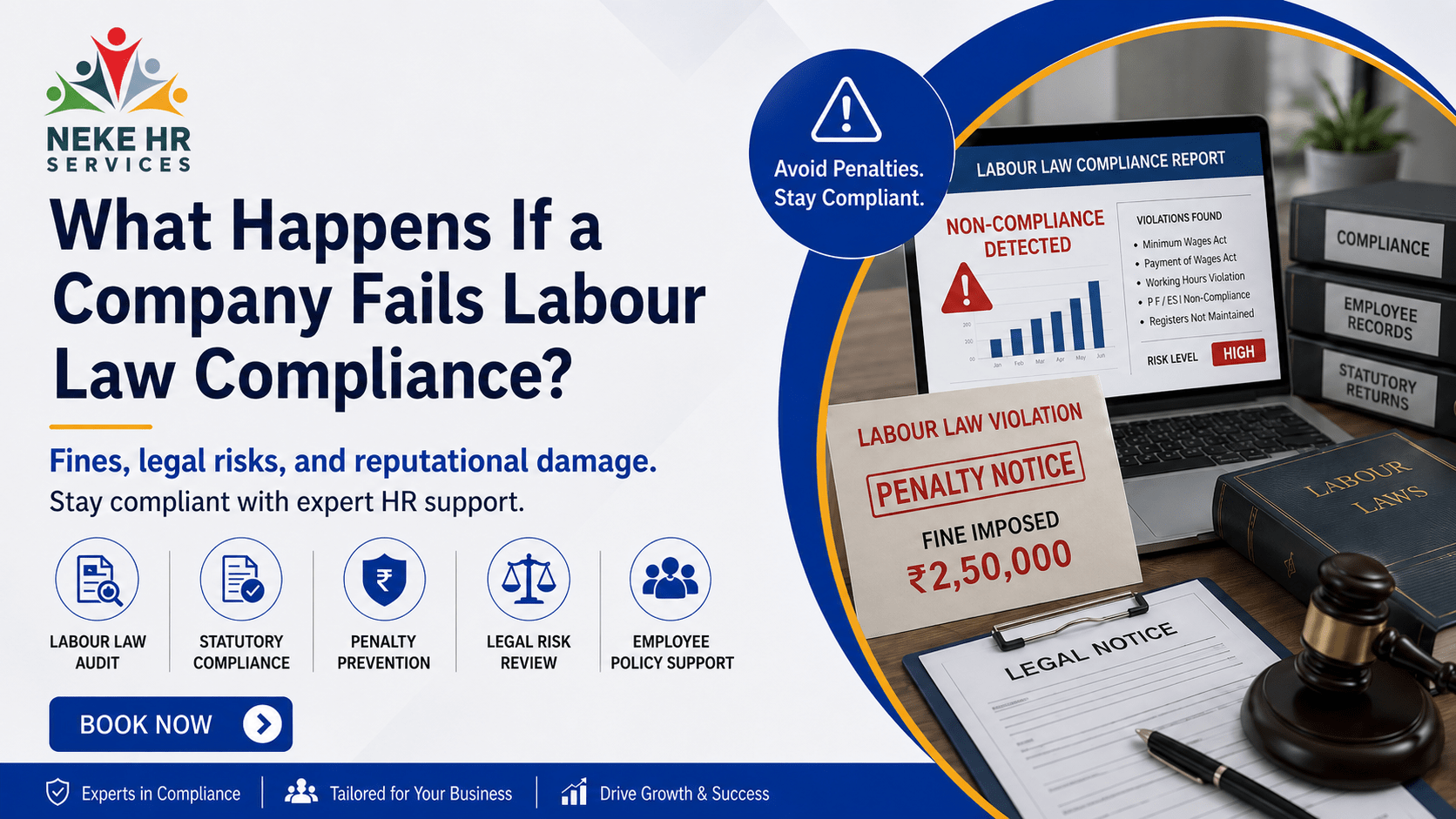
The first thing that happens after a failed inspection is usually a penalty notice. Under the Factories Act, fines run into tens of thousands of rupees per violation, and defaults that continue day after day attract daily fines on top. If your workers have been paid below the minimum wage , even slightly, even for a long time , inspectors can demand you pay back every rupee of the shortfall, going back years, with interest added on.
That last part catches businesses off guard more than anything else. They assume the fine is the problem. In practice, the arrears demand is often far larger than the fine itself.
It’s Not Just the Company That Faces Prosecution , It’s You, Personally
This is the consequence most people aren’t prepared for. Several Tamil Nadu labour laws , the Factories Act being the clearest example , allow prosecution of individual directors, managers, and whoever was effectively running the show at the time of the violation. Not just the company as a legal entity. You, personally.
Conviction under the Factories Act can mean imprisonment. Two years, in serious cases. The courts have generally taken a dim view of the argument that senior management didn’t know about violations happening on their premises. Being in charge comes with accountability, and labour law is one area where that accountability is taken quite literally.
Operations Can Be Stopped
For factories and manufacturing units, this is the one that keeps owners up at night. If a labour inspector finds safety violations that are serious enough , or finds that previous orders have been ignored , they have the authority to recommend shutting down operations, or parts of them. The Chief Inspector under the Factories Act can prohibit use of a section of a factory outright.
Think about what that means for a production floor. For a business with delivery commitments, export schedules, or tight cash flow, even a week’s stoppage can cause damage that takes months to recover from. The penalty amount becomes almost irrelevant at that point.
Employees Can Claim Back What They’re Owed
When an inspection or a formal complaint uncovers unpaid dues , missing PF contributions, ESI amounts that were deducted but never remitted, gratuity not paid on exit, or wages short of the minimum , the company has to make it right. All of it. The EPFO and ESIC have strong powers to assess and recover dues, and they use them. Interest and damages get added on top of the principal amount.
If a workforce of 200 people has been underpaid by even a small margin for two or three years, the total back-payment demand can be substantial enough to affect the company’s liquidity seriously.
The Reputational Damage Lingers
Labour violations that end up in court proceedings, or that get picked up through supply chain audits by large buyers, don’t stay private. Manufacturers supplying to international brands know this better than most , audits now routinely cover wage payment practices, contract worker treatment, and statutory compliance. A company that fails one of those audits can lose a contract quickly. Getting back in takes much longer.
Closer to home, word travels through industry networks. A business known for compliance failures finds it harder to attract good people, retain contractors, and build the kind of credibility that supports long-term growth.
Which Businesses Get Caught Out Most Often?
Inspections aren’t random, in practice. Labour enforcement tends to concentrate in areas and sectors where violations are most likely. Based on what we see on the ground in Tamil Nadu:
- Manufacturing units using contract or casual labour , the Contract Labour Act is one of the most frequently violated statutes, partly because many businesses don’t realise how broadly it applies.
- Construction sites , migrant workforces, variable wage structures, and busy site supervisors create conditions where minimum wage and safety compliance frequently slips.
- Retail and hospitality businesses , working hour violations under the Shops and Establishments Act are common, particularly around weekly offs and overtime.
- Growing SMEs , companies that started small, built their practices around early-stage requirements, and then crossed statutory thresholds without adjusting. What was compliant at 18 employees may not be compliant at 22.
- IT and services firms that assume they’re largely outside the scope of traditional labour law. Sometimes they’re right. Often they’re not, particularly around contract staffing.
Getting This Right Isn’t as Daunting as It Sounds
There’s a tendency to treat labour law compliance as this enormous, shifting, unknowable thing. In practice, for most businesses, it comes down to knowing which laws apply, keeping the right records, making contributions on time, and having someone who stays on top of regulatory changes so you don’t have to.
The businesses that get into serious trouble are rarely the ones that knew the rules and ignored them. They’re the ones that didn’t have a clear picture of what applied to them, let things drift, and only discovered the gap when someone else pointed it out.
To Put It Simply
Labour law compliance failures in Tamil Nadu can lead to financial penalties, demands to repay years of employee arrears, personal prosecution of directors and managers, operational shutdowns, and lasting damage to business relationships and reputation. These aren’t edge cases that happen to careless operators , they happen to businesses that let things slide without realising how serious the exposure was.
The cost of staying compliant, done properly, is a fraction of the cost of dealing with an inspection that reveals you haven’t been.
At Neke HR Services, we help businesses across Tamil Nadu get their labour law compliance in order and keep it that way , statutory registers, returns, PF and ESI, Contract Labour licensing, and everything in between. If you’re not confident your compliance is where it should be, speak to us before an inspector does.