
- Uncategorised
- 0 Comments
What Are Factory Compliance Services? A Complete Guide for Employers
Understand what factory compliance actually involves in India, why it matters, and how the right support can keep your workplace safe, legal, and running smoothly. If you run a manufacturing facility in India, you already know there’s a fair amount of red tape involved, and honestly, most of it exists for good reason. Factory compliance services are built around one simple idea: help employers stay on the right side of the law while keeping the people on the floor safe. This guide walks through what compliance actually means in practice, why it’s worth taking seriously rather than treating it as a box-ticking exercise, and what to look for if you’re bringing in outside help to manage it. What Is Factory Compliance in India? At its core, factory compliance is about following the rules that govern how industrial facilities operate day to day. In India, most of these requirements trace back to the Factories Act, 1948, a law that’s been around a while but still forms the backbone of workplace safety regulation for manufacturing. It covers a lot of ground: safe working conditions, limits on working hours, basic welfare provisions like clean drinking water and washrooms, and rules around machinery and hazardous processes. None of this is abstract. These regulations exist because factories are genuinely dangerous places when things go wrong, heavy machinery, chemical exposure, long shifts, tight spaces. The rules aren’t there to slow businesses down for no reason; they’re there because someone, somewhere, got hurt badly enough that lawmakers decided to act. Skip compliance, and you’re not just risking a fine from an inspector. You’re risking someone’s hand, or worse. Why Do Employers Need Factory Compliance Services? Here’s the honest answer: factory regulations are not light reading, and most business owners have neither the time nor the legal background to interpret them correctly on their own. A single missed renewal or an overlooked safety requirement can snowball into serious trouble, production halts, legal notices, sometimes even facility shutdowns until issues are resolved. Compliance services exist to take that burden off your plate. A good provider knows the regulatory landscape inside out, tracks changes as they happen and they do happen more often than people expect, and makes sure your facility isn’t caught off guard. That’s the practical, defensive side of it. But there’s an upside beyond just avoiding penalties. Workers notice when a company actually invests in their safety, it shows up in morale, in how long people stick around, and in whether they’d recommend the job to someone else. Job seekers notice too, particularly in a market where skilled labor has options. A factory with a clean compliance record and a visible safety culture tends to attract better talent and keep it longer. It’s not just risk management; it’s a quiet form of employer branding. Key Factory Compliance Services Employers Should Know Workplace Safety Audits This is usually where it starts. Regular safety audits mean someone is actually walking the floor, checking machinery guards, inspecting fire exits, testing emergency equipment, and looking at how workers move through the space. The point isn’t to catch people doing something wrong, it’s to catch problems before they turn into accidents. A good audit report doesn’t just list issues; it prioritizes them so you know what needs fixing today versus what can wait a quarter. Factory Licensing and Registration Factories need a stack of licenses and permits to legally operate, and a lot of these come with renewal deadlines that are easy to lose track of, especially if you’re running more than one facility. Compliance providers typically handle this from start to finish: tracking expiry dates, preparing paperwork, liaising with the relevant authorities, and making sure nothing lapses without your knowledge. Employee Safety Training Programs Rules written into a policy document don’t do much good if the people on the ground don’t actually know them. Training sessions, on safety protocols, emergency evacuation, proper use of protective equipment, help turn compliance from a paper exercise into something workers actually carry with them. The best programs aren’t a one-time induction; they’re refreshed periodically, because habits fade and new hires need the same grounding. Environmental Compliance for Factories This part often gets overlooked, but it’s growing in importance. Factories have obligations around waste disposal, effluent treatment, air quality, and general sustainability practices, and regulators are tightening these standards fairly consistently. Getting ahead of environmental compliance, rather than scrambling to react to a new rule, tends to save both money and headaches down the line. Compliance Recordkeeping and Documentation When an inspector shows up, the first thing they’ll ask for is paperwork, audit reports, incident logs, training records, license copies. Having this organized and current isn’t glamorous work, but it’s often what separates a smooth inspection from a stressful one. Compliance services usually help set up systems so this documentation stays current without someone scrambling to assemble it last minute. Building a Culture of Workplace Compliance Together No single person can carry factory compliance alone, and treating it as purely a legal department’s job usually backfires. It works best as a shared effort, employers set the tone and commit real resources to it, workers follow through in their daily routines, regulatory bodies set the standards, and a compliance partner fills in the technical and legal expertise most businesses simply don’t have in-house. At the end of the day, compliance isn’t just paperwork sitting in a filing cabinet somewhere. It’s what actually keeps people safe on the factory floor, day after day. Getting it right protects your workers first, but it also protects your business, its reputation, its ability to operate without interruption, and its standing in an industry where trust matters more than people often give it credit for. Conclusion Factory compliance is not just about meeting legal requirements; it is about creating a workplace where employees can work safely and the business can operate without unnecessary risk or disruption. From licensing and safety audits to employee training, documentation, labour compliance, PF and ESI requirements,

Hrneke
How Statutory Compliance Helps Businesses Avoid Legal Penalties?
Most businesses do not lose money to statutory non-compliance in one dramatic incident. It happens quietly, a missed PF deposit here, an unregistered contract worker there, a professional tax filing that slipped by a month, until an inspection or an employee complaint brings the whole picture into view at once. By then, what could have been a routine correction has become interest, damages, and in some cases prosecution. Statutory compliance exists precisely to prevent that build-up, and understanding how it works is the first step towards avoiding the penalties it is designed to guard against. What Statutory Compliance Actually Covers? Statutory compliance refers to the legal framework an employer must operate within concerning wages, social security, working conditions, and workplace safety. In India, this has recently undergone its biggest overhaul in decades. Four labour codes, the Code on Wages, the Industrial Relations Code, the Code on Social Security, and the Occupational Safety, Health and Working Conditions Code, came into force on 21 November 2025, consolidating twenty-nine older central laws into a single framework. For employers in Tamil Nadu, this transition carries a particular wrinkle. As of mid-2026, several major industrial states, Tamil Nadu among them, have not yet finalised their state-level rules under the new codes, while states such as Gujarat, Karnataka, and Madhya Pradesh already have. In practice, this means Coimbatore businesses must continue complying with both the older legacy Acts and the new codes simultaneously until Tamil Nadu notifies its own rules, a transitional period that catches out employers who assume the old rulebook has already been retired. Why the Definition of Wages Now Matters More? One of the most consequential changes under the new codes concerns how wages are defined. Allowances that were traditionally excluded from wage calculations, such as house rent allowance and conveyance, are now capped at 50 per cent of total remuneration. Anything paid above that cap gets reclassified as wages for the purpose of calculating PF, ESI, and gratuity contributions. Businesses that have not reviewed their salary structures against this rule risk under-contributing without realising it, an error that surfaces only when the figures are checked against the new definition during an audit. The Cost of Getting It Wrong The financial penalties attached to non-compliance have grown sharper under the new framework, not softer. A first offence under the Code on Wages can attract a fine of up to ₹50,000, while a repeat offence within five years can mean imprisonment of up to three months alongside a fine reaching ₹1 lakh. Violations under the Industrial Relations Code can draw fines of up to ₹5 lakh. There is some relief built in for first-time, unintentional lapses, since a first offence is generally compoundable at 50 per cent of the maximum fine for fine-only violations, but repeat offences within five years lose that option entirely. Gratuity obligations have also shifted meaningfully. Fixed-term employees now qualify for gratuity after just one year of continuous service rather than the previous five, and the overall gratuity ceiling has doubled from ₹10 lakh to ₹20 lakh. Businesses that still budget and calculate gratuity liability on the old thresholds are quietly under-provisioning for an obligation that has become considerably larger. Contract Labour Is Where Liability Quietly Transfers Principal employer liability is one of the areas businesses in Coimbatore’s manufacturing and engineering clusters consistently underestimate. Where a contractor fails to deposit PF or ESI contributions, or fails to pay wages, for workers deployed at a client’s premises, that liability does not stay with the contractor. It transfers to the principal employer, regardless of any indemnity clause written into the contract. An HR compliance in Coimbatore programme that only checks a contractor’s registration certificate at onboarding, without ongoing verification of monthly filings, is not actually managing this risk. Compliance Management as an Ongoing Discipline Inspections themselves have changed character. The older, largely manual inspection system is giving way to a data-driven, digital model, increasingly described as Inspector-cum-Facilitator inspections, where payroll data, filing history, and employee complaints are cross-referenced through analytics rather than relying solely on a physical site visit. This shift means gaps that once went unnoticed for years are now considerably more likely to surface quickly, which raises the practical value of treating compliance management as a continuous monthly discipline rather than an annual scramble before an audit. Professional tax, a state-level levy that varies by state and is easy to overlook precisely because it operates outside the PF and ESI conversation, illustrates this well. Employers are required to register within thirty days of hiring, deduct the tax monthly, and deposit it on time, with late penalties typically ranging from 10 to 50 per cent of the amount due. It is a small line item individually, but one that accumulates quickly across a growing workforce if nobody owns the filing calendar. Why This Matters Beyond the Fine Itself? The direct financial penalty is rarely the most expensive part of non-compliance. A poor compliance record surfaces during due diligence for funding rounds, larger client contracts, and bank credit assessments, well beyond the immediate cost of the fine itself. For growing businesses trying to build credibility with investors or larger corporate clients, a clean statutory compliance record has become a genuine commercial asset rather than a purely defensive one. Building Compliance Management Around Local Reality Meeting these legal requirements consistently is less about knowing every provision of the new codes and more about having a system that tracks deadlines, wage definitions, and contractor filings without depending on any single person remembering all of it. For businesses operating out of Coimbatore, where the transition between old and new frameworks is still incomplete, that discipline matters more, not less. Neke HR Services supports growing businesses across Tamil Nadu with statutory compliance management that stays current with both the legacy rules still in force and the new codes taking shape around them.
Hrneke
Benefits of Outsourcing Payroll Management for Growing Businesses
A business that has just crossed twenty or thirty employees rarely notices the moment payroll stopped being simple. What used to be a spreadsheet updated once a month slowly turns into a recurring source of pressure: new joiners to add, exits to process, PF and ESI contributions to calculate correctly, and a salary date that arrives whether or not anyone had time to double-check the numbers. This is usually the point at which payroll outsourcing shifts from a nice-to-have to a genuine operational decision. Why Payroll Gets Harder as Business Grows? Payroll management is deceptively simple in theory and unforgiving in practice. Every payslip touches attendance data, leave balances, tax deductions, statutory contributions, and reimbursements, and a single error in any one of those inputs can ripple through an entire pay cycle. India’s payroll outsourcing market reflected this pressure well before it became visible to most business owners. The sector was valued at roughly USD 359.2 million in 2025 and is projected to reach USD 592.1 million by 2034, driven largely by the compliance burden that comes with PF, ESI, and constantly shifting tax regulations. Payroll now ranks among the three most frequently outsourced business functions in India, alongside IT and finance, a reflection of just how many growing companies have concluded that in-house salary processing no longer makes sense past a certain size. Time Reclaimed for What Actually Grows the Business The most immediate benefit of outsourcing payroll is also the easiest to underestimate: time. Calculating gross-to-net pay, reconciling attendance records, generating payslips, and filing statutory returns each month consumes hours that could otherwise go towards hiring, client work, or product development. For a founder or an HR generalist juggling recruitment, onboarding, and grievance handling alongside payroll, that time cost compounds every single month. Handing salary processing to a specialist team frees that bandwidth for work that has a direct bearing on growth, rather than administrative tasks that simply have to happen. Fewer Errors, Fewer Penalties Manual payroll processing is where small mistakes turn into expensive ones. A misclassified allowance, a missed PF deduction, or a late TDS filing rarely announces itself immediately; it tends to surface months later during an audit or an employee query, by which point interest and penalties have already accrued. Established payroll outsourcing providers use dedicated software and experienced teams who process salaries for a living, which meaningfully reduces the error rate compared with a generalist handling it as one task among many. Given how frequently Indian labour law changes, particularly with the ongoing transition to the new labour codes, a provider that tracks these updates as part of their core job is generally better positioned to keep a business compliant than an internal team stretched across several responsibilities. Cost Efficiency That Is Easy to Miss On paper, outsourcing looks like an additional expense. In practice, building an equivalent in-house capability, dedicated payroll staff, software licences, ongoing training on regulatory changes, and the infrastructure to keep employee data secure, typically costs considerably more than a service fee. This is particularly true for small and medium businesses that cannot justify a full payroll department but still need the same level of accuracy as a larger company. Outsourcing effectively bundles expertise, technology, and compliance knowledge into one predictable cost, which tends to work out cheaper than replicating all three internally. Compliance Without the Constant Catch-Up Statutory compliance in India is not a once-a-year task; it runs on a monthly rhythm of PF deposits, ESI contributions, and TDS filings, each with its own deadline and its own penalty structure for late payment. A specialist payroll partner keeps track of every one of these deadlines as a matter of routine, rather than as an occasional item on someone else’s to-do list. This matters even more for businesses operating out of Coimbatore’s manufacturing and engineering clusters, where contract labour and shift-based pay structures add further complexity to an already dense set of rules. Scaling Without Rebuilding the Payroll Function A business with fifteen employees and one with one hundred and fifty need fundamentally the same accuracy from payroll, but very different levels of infrastructure to deliver it. Outsourced payroll solutions scale with headcount without requiring a business to hire additional payroll staff or invest in new software each time it grows. Whether the growth comes from a single new hiring round or an expansion into a second location, an experienced provider absorbs that complexity rather than passing it back to an already stretched internal team. Better Data Security Better Data Security Than Most Businesses Realise!Payroll data sits among the most sensitive information any company holds, salary figures, bank details, and tax records among them. Reputable payroll outsourcing providers typically invest in encrypted systems, access controls, and secure servers that go well beyond what a smaller business would build for itself. For companies without a dedicated IT security function, this is often an underappreciated benefit of moving payroll outside the organisation rather than managing it on a shared drive or a locally installed spreadsheet. A Better Experience for Employees Too Salary processing outsourcing is not only a back-office decision; it shows up directly in how employees experience their pay. Digital payslips, self-service access to tax documents, and faster resolution of payroll queries all tend to improve once a specialist provider is managing the process, since these are features built into their standard offering rather than something an internal team has to develop from scratch. Where This Leaves Growing Businesses in Coimbatore? For companies scaling up across Coimbatore’s manufacturing, textile, and IT sectors, the choice is rarely between doing payroll well internally or outsourcing it. It is between building that capability from the ground up at real cost, or partnering with a provider that already has it running. Neke HR Services works with growing businesses across Tamil Nadu to manage payroll services in Coimbatore accurately, on schedule, and fully compliant, so that internal teams can spend their time on the work that actually moves the business forward.
Hrneke
What Are ESI and PF Compliance Services? A Complete Guide for Employers
For most business owners in Coimbatore, the words “statutory compliance” arrive attached to a deadline, not an explanation. A notice from EPFO, a query from ESIC, or a payroll error flagged during an audit tends to be the first proper introduction anyone gets to ESI and PF. By then, the cost of not understanding the rules has already started adding up. This guide sets out what ESI and PF compliance services actually cover, why the two schemes exist, and what employers running payroll in Tamil Nadu need to get right each month. What ESI Compliance Actually Involves? The Employees’ State Insurance Scheme, administered by the Employees’ State Insurance Corporation under the ESI Act, 1948, provides medical and financial protection to employees earning within a prescribed wage limit. Any factory or notified establishment employing ten or more people (twenty in a handful of states) must register once even one employee falls within the eligible wage bracket. The current ESI wage ceiling stands at ₹21,000 a month in gross wages, rising to ₹25,000 for persons with disabilities, a figure unchanged since January 2017. Gross wages here means basic pay, dearness allowance, house rent allowance, and other regular cash components, calculated before any deductions, not the basic salary figure alone. This distinction trips up a fair number of payroll teams, since an employee with a modest basic salary but a higher HRA can sit above the ceiling despite looking eligible on paper. Contribution is split between employer and employee: 3.25 per cent from the employer and 0.75 per cent from the employee, totalling 4 per cent of gross wages, a rate that has held since July 2019. Both shares are deducted and deposited by the employer, due by the fifteenth of the following month under Regulation 31 of the ESI (General) Regulations, 1950. What PF Compliance Actually Involves? The Employees’ Provident Fund, governed by the EPF and Miscellaneous Provisions Act, 1952, and administered by the Employees’ Provident Fund Organisation, is a retirement savings scheme rather than a medical one. Registration becomes mandatory once an establishment crosses twenty employees on any day in the preceding financial year, with fifteen days allowed to complete registration after that threshold is met. Unlike ESI, PF is calculated on basic salary plus dearness allowance, not gross wages, at 12 per cent from both employer and employee. The mandatory wage ceiling for PF sits at ₹15,000 a month, though employees earning above this figure may join voluntarily with the employer’s consent if they were not already members elsewhere. Out of the employer’s 12 per cent share, 8.33 per cent routes to the Employees’ Pension Scheme on wages up to the ₹15,000 cap, with the remainder going to the provident fund account itself. PF deposits, filed through the Electronic Challan-cum-Return on the EPFO portal, follow the same fifteenth-of-the-month deadline as ESI. Why Do the Two Schemes Get Confused? Employers frequently treat ESI and PF as a single combined obligation, largely because both apply to the same payroll cycle and share a due date. In practice, they run on different wage definitions, different ceilings, different registration thresholds, and different penalty structures, which is precisely where errors creep in. A common mistake involves applying the PF wage base to ESI calculations, or vice versa, resulting in either under-deduction that surfaces during an inspection or over-deduction that erodes employee take-home pay for no good reason. Contract and part-time staff add a further layer of complexity. Workers deployed through a staffing agency still count towards the employer’s headcount threshold for both schemes, and the principal employer carries secondary liability if a contractor fails to register or pay contributions for deployed workers. For manufacturing and engineering units around Coimbatore that rely heavily on contract labour, this is one of the more overlooked compliance gaps. What Happens When Deadlines Are Missed? Late ESI payments attract simple interest at 12 per cent per annum from the day after the due date, with additional damages of up to 25 per cent of the arrears for prolonged delays, and prosecution remains possible under Section 85 of the ESI Act for repeated or wilful default. PF carries a comparable structure under Sections 14B and 7Q of the EPF Act, with damages that can run from 5 per cent to 100 per cent of the arrears depending on how long the default continues. Beyond the financial penalty, a poor compliance record surfaces during labour department inspections, bank credit assessments, and due diligence for larger contracts, making timely filing a reputational matter as much as a legal one. Why Employers Outsource ESI and PF Compliance? A business with twenty or two hundred employees faces the same fundamental obligation: accurate wage classification, correct contribution calculation, and on-time deposit, month after month, without exception. What changes with scale is the margin for error. A single misclassified allowance or a missed registration for a new contract worker can sit unnoticed for months before it becomes a liability that has to be settled retroactively, with interest attached. This is the gap an experienced EPF consultant is built to close. Rather than leaving statutory filing to whoever in the finance team has a spare afternoon, dedicated compliance support tracks wage revisions, flags employees crossing the ESI ceiling mid-period, manages new joiner and exit updates on both portals, and keeps documentation ready for the inspections that arrive with little warning. Building Payroll Compliance in Coimbatore Around the Right Support Coimbatore’s mix of manufacturing, engineering, textiles, and a growing IT sector means the businesses relying on ESI and PF compliance in Coimbatore rarely look alike, yet the underlying obligations stay identical for all of them. Getting the wage definitions right, hitting the fifteenth-of-the-month deadline consistently, and keeping registration current as headcount grows are not complicated tasks individually, but they are easy to let slip when they sit alongside a dozen other priorities. Neke HR Services works with employers across Tamil Nadu to keep PF compliance and ESI compliance running quietly in the background, correctly calculated, filed on schedule,
Hrneke

What Happens If a Company Fails Labour Law Compliance in Tamil Nadu?
Most businesses don’t set out to break labour laws. It creeps in slowly. A statutory register that nobody remembered to update. A licence renewal that got buried under more urgent work. A new act that came into force six months ago and somehow nobody in the office heard about it. Before long, there’s a gap , sometimes several , and the company is technically non-compliant without anyone having made a conscious decision to be. Tamil Nadu’s labour department doesn’t grade businesses on intent, though. An inspection is an inspection, and what the inspector finds on the day is what matters. The state runs one of the more active enforcement environments in the country, and the outcomes of being found wanting go well beyond a slap on the wrist. This piece is for business owners and HR managers who want to understand , plainly, without the legal jargon , what the real consequences of labour law compliance failures look like in Tamil Nadu. Not worst-case scaremongering. Just what actually happens. First, a Word on How Many Laws Actually Apply to You This is where a lot of businesses come unstuck. They assume they know which laws cover them, and they’re often only half right. Labour law compliance in Tamil Nadu isn’t one thing , it’s a collection of central and state laws, each with its own scope, its own thresholds, and its own set of obligations. A few of the main ones: The Factories Act, 1948 , if you run a premises with 10 or more workers using power (or 20 without power), this applies to you. It covers everything from working hours and leave to welfare facilities and safety obligations. The Contract Labour Act, 1970 , if your business uses contract workers above a certain number, both you and your contractors need to be licensed. Many companies miss this entirely. The Minimum Wages Act, 1948 , Tamil Nadu notifies minimum wages for different categories of workers, and these get revised. You need to be paying the current rate, not the one from three years ago when you last checked. The Shops and Establishments Act , covers commercial establishments: working hours, weekly offs, holiday entitlements, and how you treat staff generally. PF and ESI legislation , once your headcount crosses the applicable threshold, registration and contributions aren’t optional. The EPFO and ESIC both run their own compliance monitoring. Gratuity and Bonus Acts , entitlements that employees have a legal right to, regardless of whether your employment contract mentions them. The point isn’t to list every applicable statute. It’s to make clear that compliance isn’t one checkbox , it’s a set of ongoing obligations that sit across multiple laws, and gaps can appear in any of them. What the Consequences Actually Look Like? You’ll Be Hit Financially , and It Can Get Significant The first thing that happens after a failed inspection is usually a penalty notice. Under the Factories Act, fines run into tens of thousands of rupees per violation, and defaults that continue day after day attract daily fines on top. If your workers have been paid below the minimum wage , even slightly, even for a long time , inspectors can demand you pay back every rupee of the shortfall, going back years, with interest added on. That last part catches businesses off guard more than anything else. They assume the fine is the problem. In practice, the arrears demand is often far larger than the fine itself. It’s Not Just the Company That Faces Prosecution , It’s You, Personally This is the consequence most people aren’t prepared for. Several Tamil Nadu labour laws , the Factories Act being the clearest example , allow prosecution of individual directors, managers, and whoever was effectively running the show at the time of the violation. Not just the company as a legal entity. You, personally. Conviction under the Factories Act can mean imprisonment. Two years, in serious cases. The courts have generally taken a dim view of the argument that senior management didn’t know about violations happening on their premises. Being in charge comes with accountability, and labour law is one area where that accountability is taken quite literally. Operations Can Be Stopped For factories and manufacturing units, this is the one that keeps owners up at night. If a labour inspector finds safety violations that are serious enough , or finds that previous orders have been ignored , they have the authority to recommend shutting down operations, or parts of them. The Chief Inspector under the Factories Act can prohibit use of a section of a factory outright. Think about what that means for a production floor. For a business with delivery commitments, export schedules, or tight cash flow, even a week’s stoppage can cause damage that takes months to recover from. The penalty amount becomes almost irrelevant at that point. Employees Can Claim Back What They’re Owed When an inspection or a formal complaint uncovers unpaid dues , missing PF contributions, ESI amounts that were deducted but never remitted, gratuity not paid on exit, or wages short of the minimum , the company has to make it right. All of it. The EPFO and ESIC have strong powers to assess and recover dues, and they use them. Interest and damages get added on top of the principal amount. If a workforce of 200 people has been underpaid by even a small margin for two or three years, the total back-payment demand can be substantial enough to affect the company’s liquidity seriously. The Reputational Damage Lingers Labour violations that end up in court proceedings, or that get picked up through supply chain audits by large buyers, don’t stay private. Manufacturers supplying to international brands know this better than most , audits now routinely cover wage payment practices, contract worker treatment, and statutory compliance. A company that fails one of those audits can lose a contract quickly. Getting back in takes much longer. Closer to home, word travels through industry networks.
Hrneke
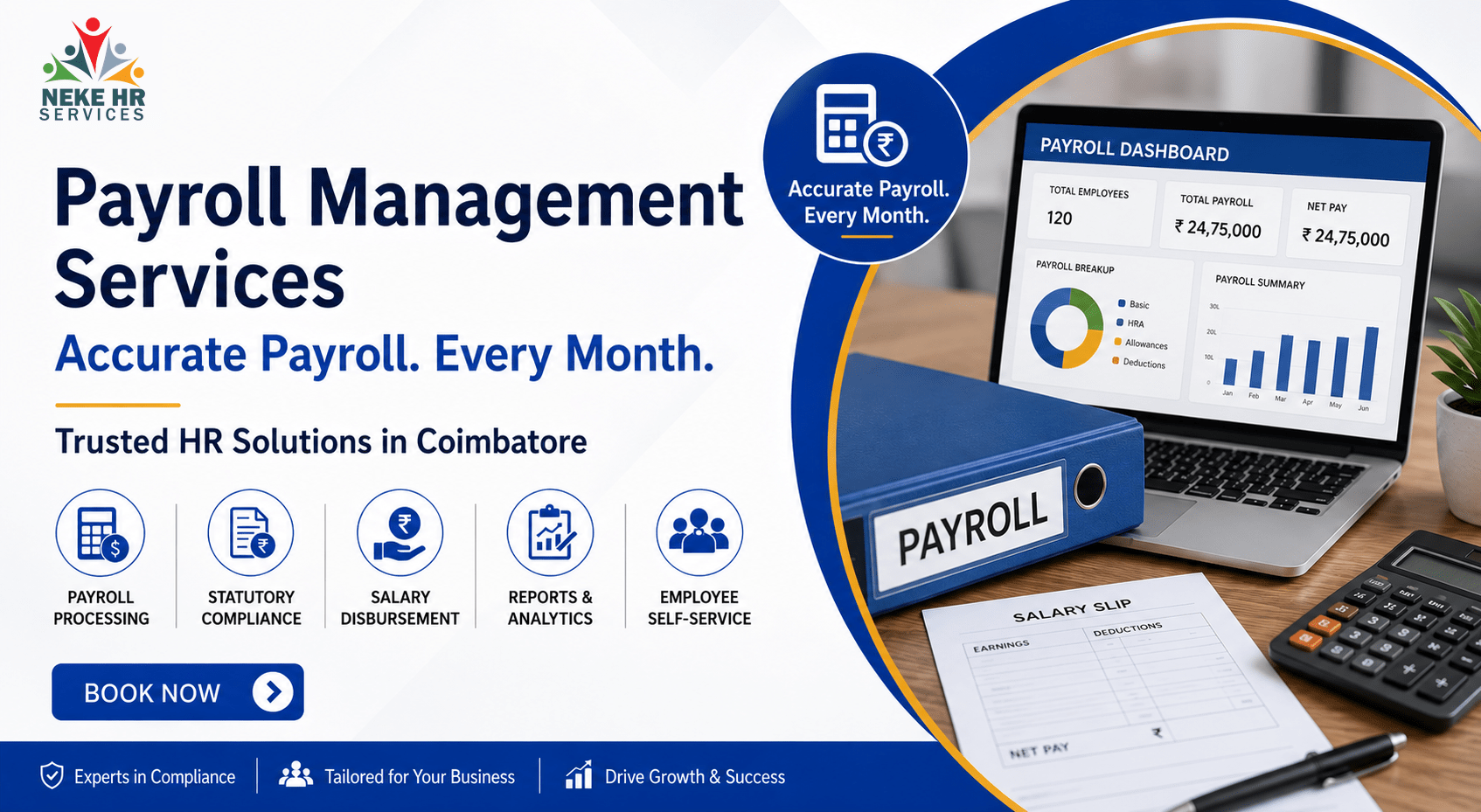
Payroll Management Services in Coimbatore: What You Actually Get and Why Outsourcing Makes Sense
Nobody starts a business thinking, ‘I can’t wait to manage payroll every month.’ Yet somehow, payroll ends up consuming more time, causing more stress, and creating more compliance headaches than almost anything else in a growing company. Talk to any business owner or HR manager in Coimbatore who has been through a statutory audit, a misfiled PF return, or an angry employee who received the wrong salary , and they’ll tell you the same thing. Payroll looks simple from the outside. It really doesn’t feel that way once you’re inside it. That’s why there’s been a steady and quite noticeable shift towards payroll management services in Coimbatore over the past few years. Not just among large companies with dedicated finance teams, but among mid-sized manufacturers, IT firms, logistics businesses, and startups who’ve simply decided their time is better spent elsewhere. This piece walks through what a proper payroll management service actually covers, and why more businesses are choosing to hand it over to specialists rather than keep struggling with it in-house. What’s Actually Included in a Payroll Management Service? One of the most common assumptions is that outsourcing payroll just means someone else runs the numbers and sends out payslips. That’s a small part of a much bigger picture. Here’s what a proper service covers: Salary Processing , Done Right, Every Month This is the foundation. Your provider takes inputs , attendance data, leave records, new joiners, exits, salary revisions, variable pay , and produces accurate payslips for every employee. The key word there is accurate. An error on a payslip doesn’t just cause an administrative headache; it erodes trust, and trust is hard to rebuild once it’s gone. Statutory Compliance , the Part That Trips Most Businesses Up India has one of the more complex payroll compliance environments in the world. Provident Fund contributions, ESI deductions, Professional Tax (which varies by state and sometimes by municipality), Labour Welfare Fund, and TDS under Section 192 , each has its own rates, thresholds, deadlines, and filing formats. The regulations also change. The EPFO revises its guidelines. State governments update Professional Tax slabs. New circulars come through that affect how certain allowances are treated. Keeping up with all of this as a side responsibility, while also running a business, is genuinely difficult. A payroll management team does this full-time , it’s the whole job, not an afterthought. TDS and Year-End Tax Management Every employee’s tax situation is slightly different. Different salary structures, different investment declarations, different exemptions. Calculating the right TDS each month, adjusting it mid-year when someone changes their declarations, filing quarterly 24Q returns, and issuing Form 16 at the end of the year , this is a year-round process. Get it wrong and your employees face unexpected tax dues in March. Get it right and nobody has to think about it. Attendance Integration and Variable Pay Payroll is only as accurate as the data feeding into it. Loss of pay deductions, overtime, shift allowances, incentive payouts, leave encashments , all of it needs to flow correctly from your attendance or HR system into the payroll calculation. Good providers integrate with what you already use so you’re not manually reconciling two systems every month. Full and Final Settlements When an employee leaves, their settlement has to be right , legally right, not just approximately right. Gratuity entitlement, earned leave encashment, notice period recovery or payment, TDS on the final amount, relieving date adjustments. Errors in F&F settlements are one of the most common triggers for labour disputes. Having a specialist handle it properly protects both the departing employee and the company. Payroll Reports That Help You Manage the Business Beyond processing, a good payroll management service gives you meaningful data , monthly cost-to-company reports, department-wise breakdowns, statutory contribution statements, and year-on-year payroll cost trends. This is the information that feeds into headcount planning, budget decisions, and board presentations. It shouldn’t require your HR team to build it manually every month from a spreadsheet. Why Are Businesses in Coimbatore Moving to Outsourced Payroll? The motivations differ from one business to the next, but a few come up consistently when you talk to owners and HR heads across the city. Compliance Has Become Too Specialised to Handle Casually Five years ago, a reasonably diligent in-house accounts person could stay on top of payroll compliance with some effort. Today, it’s a different story. Between EPFO’s digital compliance push, the GST interface for professional tax in some states, and the frequency of regulatory notifications, staying current requires dedicated attention. Businesses that outsource this aren’t admitting weakness , they’re making a smart call about where to apply their internal expertise. The Real Cost of Doing It In-House is Usually Underestimated When businesses actually sit down and add up the cost of managing payroll internally , staff salaries, payroll software subscriptions, training time, compliance penalties from errors, and the hours senior HR professionals spend on tasks a specialist could do faster , outsourcing usually works out cheaper. And a payroll service provider doesn’t go on leave the week your payroll needs to run. Your HR Team Deserves Better Work to Do This one doesn’t get said enough. HR professionals are often the most overqualified people in the room for payroll data entry. Their real value is in hiring the right people, resolving difficult situations, building culture, and supporting managers , not in chasing attendance reports and cross-referencing PF challans. Outsourcing payroll gives your HR team their time back and lets them focus on work that actually builds the organisation. Growth Doesn’t Have to Mean More Payroll Complexity Coimbatore’s business landscape is expanding , new manufacturing units, software companies, healthcare facilities, and retail chains are all adding headcount at pace. Every time a business grows, payroll gets more complex. More employees, more departments, potentially new locations with different state compliance requirements. An outsourced payroll setup scales with you naturally, without you having to rebuild the process from scratch each time. Which Businesses See the Most Value? Almost
Hrneke
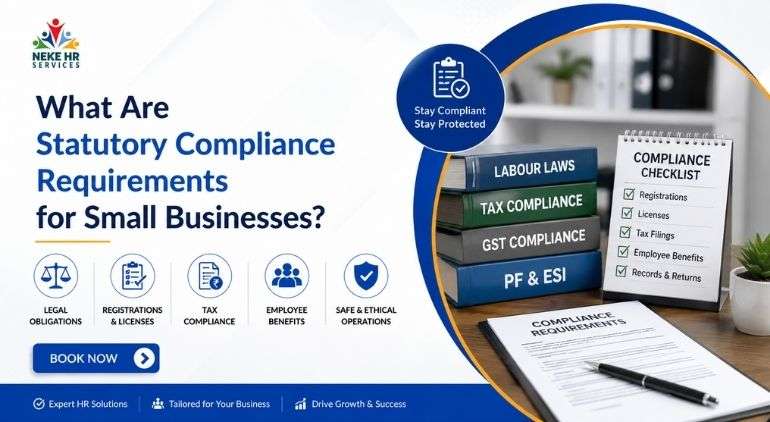
What Are Statutory Compliance Requirements for Small Businesses in India?
Small business owners in India carry a particular kind of pressure that larger organisations rarely understand from the inside. You are simultaneously the decision-maker, the operator, the sales team, and often the person signing off on payroll at eleven o’clock on a Friday night. The idea of sitting down with a stack of compliance documents and working out exactly which laws apply to your establishment, which registrations you need, which returns are due by when, and what happens if you’ve missed something- it gets pushed to later. And later keeps moving. The problem is that statutory compliance doesn’t pause while you’re busy running the business. Deadlines arrive regardless. Inspectors visit without prior notice. Penalties accumulate on obligations that were never on your radar. And the moment a compliance gap surfaces, through an inspection, a dispute, or an audit, the cost of addressing it reactively is almost always higher than the cost of staying on top of it would have been. This piece is a practical, plain-language guide to the statutory compliance requirements that small businesses in India need to understand and manage. Not an exhaustive legal textbook, but a clear overview of what applies, why it matters, and where the common pressure points are. What Statutory Compliance Actually Means for a Small Business Statutory compliance refers to the legal obligations a business must fulfil under applicable central and state laws, covering how employees are paid, what deductions must be made and remitted, what working conditions must be maintained, what records must be kept, and what returns must be filed with government authorities. The framework governing this in India draws from multiple pieces of legislation, some central, some state-specific, some applicable from the first employee, and some kicking in only once a threshold headcount is reached. Understanding which laws apply to your specific establishment is the essential starting point, because compliance is not a uniform exercise. A manufacturing unit with fifteen workers in Tamil Nadu has different obligations from a retail shop with eight staff in Maharashtra. India has been consolidating its labour legislation into four labour codes: the Code on Wages, the Industrial Relations Code, the Code on Social Security, and the Occupational Safety, Health and Working Conditions Code, which are intended to simplify this landscape significantly. However, until state governments notify the rules under these codes, existing legislation continues to apply in most states. Navigating this transitional period requires current, local knowledge. Registration Obligations, The Starting Point Before a business employs anyone, certain registrations are required. Getting these right from the beginning establishes a clean compliance foundation. Trying to sort them out retrospectively, particularly after an inspection has flagged their absence, is considerably more complicated. Shops and Establishments Registration Every business operating on commercial premises- a shop, an office, or a service establishment- must register under the applicable state Shops and Establishments Act. In Tamil Nadu, this is the Tamil Nadu Shops and Establishments Act. Registration is typically required within thirty days of commencing operations and must be renewed periodically. This registration governs working hours, rest intervals, weekly holidays, leave entitlements, and conditions of employment for workers in commercial establishments. Inspectors from the labor department routinely check for valid registration during visits, and operating without it is a straightforward compliance failure that draws attention to everything else. Provident Fund Registration Once a business reaches twenty employees, registration under the Employees’ Provident Funds and Miscellaneous Provisions Act, 1952, becomes mandatory. Both employer and employee contribute to the Provident Fund, currently twelve per cent of basic wages each, and the employer is responsible for deducting the employee’s contribution from salary and remitting both contributions to the EPFO by the fifteenth of the following month. Smaller establishments with fewer than twenty employees can register voluntarily. For businesses approaching the threshold, understanding the registration trigger and preparing for it in advance prevents the scramble of trying to register and achieve compliance simultaneously after the threshold is crossed. ESI Registration The Employees’ State Insurance scheme, providing health insurance and sickness, maternity, and disability benefits, applies to establishments with ten or more employees where workers earn up to a prescribed wage ceiling. Employer contribution is currently 3.25 per cent of gross wages; employee contribution is 0.75 per cent. Registration with the ESIC and monthly contribution remittance are mandatory once the threshold is met. Professional Tax Registration Professional tax is a state-level levy on employment income, and both employers and employees have obligations under it in states where it applies. In Tamil Nadu, professional tax registration is required for employers who pay salaries above a specified threshold, and deduction and remittance of professional tax from employee salaries is an ongoing monthly obligation. The rates and thresholds vary by state. Labour Identification Number The Shram Suvidha Portal’s Labour Identification Number (LIN) is increasingly important for businesses subject to central labour laws. It is the reference number that consolidates a business’s identity across multiple central compliance obligations and is required for filing various returns online. Wage and Payroll Compliance Getting payroll right is not just good practice; it is a legal obligation with specific requirements under several pieces of legislation. Minimum Wages The Minimum Wages Act requires every employer to pay at least the applicable minimum wage for the scheduled employment category in which workers are engaged. Minimum wages in India are set both centrally and at the state level, and state rates, which are often higher than central rates, take precedence. Tamil Nadu revises its minimum wage schedules periodically, and staying current with applicable rates for your workforce category is an ongoing compliance responsibility. Paying below minimum wage, even unintentionally, even where workers haven’t raised a complaint, is a statutory violation that carries penalties under the Act. Timely Payment of Wages The Payment of Wages Act specifies when wages must be paid, by the seventh of the following month for establishments with fewer than a thousand workers and by the tenth for larger establishments. Delayed payment of wages is a compliance failure regardless of the business
Hrneke

What Is Employment Law Consulting and When Does Your Company Need It?
Most business owners don’t think about employment law until something goes wrong. A long-serving employee files a complaint. A labor inspector walks in unannounced. A termination that felt straightforward at the time turns into a legal dispute that drags on for months. A routine audit reveals compliance gaps that have been quietly accumulating for years, each one individually minor, collectively significant. By the time any of these situations arrive, the conversation has already shifted from prevention to damage control. And damage control in employment law is almost always more expensive, more time-consuming, and more disruptive than the compliance work that would have avoided the situation entirely. This is the fundamental case for labour law consulting, not as a luxury that large corporations use, but as a practical necessity for any business that employs people and wants to do so without incurring avoidable legal and financial risk. This piece explains what employment law consulting actually involves, what a labour law consultant does for a business on a day-to-day and strategic level, and how to recognise when your company genuinely needs professional support. What Employment Law Consulting Actually Means? Employment law consulting is the practice of providing businesses with expert guidance on the legal framework governing the employment relationship, from the moment a candidate accepts an offer to the moment an employment ends, and everything in between. In India, that legal framework is substantial. The country has moved through a significant period of labour law reform with the consolidation of over forty central labor laws into four Labour Codes, the Code on Wages, the Industrial Relations Code, the Code on Social Security, and the Occupational Safety, Health and Working Conditions Code. State-level labour laws add further layers of obligation that vary significantly depending on where a business operates. Navigating this framework, knowing which laws apply to your establishment, what your compliance obligations are under each, how to structure your HR policies to reflect current legal requirements, and how to handle situations that touch on employment law, requires knowledge that most business owners and HR teams simply don’t have in-house. Nor should they be expected to. It’s a specialised discipline. A labor law consultant brings that specialization into your business, either on a retained basis providing ongoing guidance or for specific projects such as a compliance audit, a policy review, or representation in a labor dispute. What a Labour Law Consultant Does? The scope of employment law consulting is broader than most businesses initially realize. It’s not just about handling disputes when they arise, though that’s certainly part of it. A competent consultant works across the full lifecycle of employment in your organization. Compliance Assessment and Auditing The starting point for most engagements is understanding where a business currently stands. A thorough compliance audit reviews your establishment’s registration status under applicable acts, your payroll and wage compliance, your provident fund and ESI contributions, your leave policy and its alignment with statutory requirements, your contract documentation, your standing orders, your workplace safety obligations, and your compliance with applicable state-specific regulations. For most businesses that haven’t undertaken a formal compliance review, this audit surfaces issues they didn’t know existed. Not because anyone was deliberately non-compliant, but because employment law is complex, it changes, and the day-to-day pressure of running a business leaves little time to track every obligation carefully. Policy Development and Review Employment policies, your appointment letter formats, your HR manual, your disciplinary procedures, your grievance mechanism, and your sexual harassment prevention policy need to reflect current legal requirements. Policies drafted several years ago may no longer comply with regulations that have since been updated. A labor law consultant reviews existing documentation and drafts or revises policies to ensure they are legally sound, clearly written, and enforceable if challenged. Day-to-Day HR Legal Guidance Situations that touch on employment law arise constantly in any organization. A performance management process that might be challenged as victimization. A redundancy that needs to follow a proper procedure. A disciplinary action that requires a legally compliant inquiry process. A maternity leave situation with complications. A contractor engagement that might be characterized as employment. Having a consultant available to advise on these situations as they arise , before a decision is made rather than after , is one of the most practically valuable aspects of an ongoing consulting relationship. The advice costs relatively little at the advisory stage. The consequences of acting without it can be considerably more serious. Labour Dispute Management and Representation When a dispute reaches the stage of a formal complaint, a conciliation proceeding, or a tribunal hearing, a business needs representation by someone who understands the process, the relevant law, and how to present the company’s position effectively. This is high-stakes territory. An industrial tribunal or labor court proceeding that goes against an employer can result in reinstatement orders, back-pay awards, or financial penalties that significantly affect a business. Experienced representation from a Labour Law Consultant in Coimbatore or the relevant jurisdiction makes a material difference to outcomes at this stage. Training and Awareness Managers and HR staff who understand the basic framework of employment law make better decisions , they recognise when a situation needs careful handling, they avoid the inadvertent procedural mistakes that create legal exposure, and they apply company policies consistently. Training delivered by a consultant helps build this internal capability. When Does Your Company Actually Need a Labour Law Consultant? Some specific moments and circumstances signal a business needs professional employment law support. Some are obvious. Others are less so. You are starting a new business or expanding The foundation matters enormously. Getting your establishment registrations right, structuring your employment contracts correctly from the beginning, putting proper policies in place before you have a workforce that’s operating without them , this is the cheapest and most effective time to invest in labour law consulting. Fixing structural problems retrospectively is always more complicated and more costly than building correctly from the start. You are scaling your headcount significantly Different obligations apply at
Hrneke
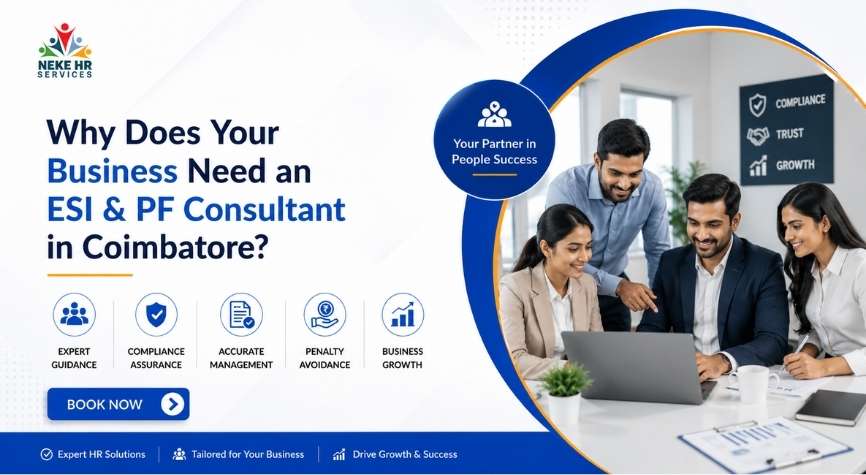
Why Does Your Business Need an ESI & PF Consultant in Coimbatore?
Most businesses in Coimbatore get into trouble with ESI and PF not because they are ignoring it, but because they assume someone internally has it covered. The payroll person thinks the accountant is handling it. The accountant thinks HR is tracking the headcount changes. Meanwhile, the ECR filings are going in with wrong figures, an eligible employee has not been registered for ESI, and a notice is sitting somewhere in the pipeline that nobody has seen yet. By the time it surfaces, the backend liability has been building for months. Sometimes longer. What Does an ESI and PF Consultant Actually Do? The short answer is that they handle the parts of statutory compliance that most businesses are not equipped to manage consistently on their own, such as registration, monthly filings, employee records, inspections, and keeping up with rule changes that come through without much warning. The longer answer depends on where your business currently is. A business that has just crossed the registration threshold for EPF or ESI needs someone to get the initial registration done correctly and set up a filing process that holds up month to month. A business that has been registered for years but has never had anyone properly audit the filings might have accumulated errors in contribution calculations, employee classification, or wage definitions that will only show up during an inspection. An ESI and PF consultant in Coimbatore who knows what they are doing will identify which of those situations applies to your business, deal with what needs immediate attention, and then build a process so the same problems do not come back. When Does a Company Need to Register for PF and ESI in India? For EPF, the trigger is 20 employees. For ESI, it is 10, and the employee must earn within the current wage ceiling to be covered under the scheme. Both figures sound straightforward until you get into how the headcount is actually calculated. A business with 14 people on permanent payroll and 8 working on contracts or part-time looks like 14 to the owner. To the EPFO inspector, it is 22. Contractual workers, fixed-term staff, part-timers, they all count. Businesses that have grown quickly and crossed that number without registering are carrying a liability that has been quietly building, and they usually do not know the size of it until someone actually checks. After registration, the work is monthly. Contributions go out, filings go in, and records stay updated. Miss a deadline by a day, and interest starts. Some delays attract damages on top of that. It is not a system that forgives inconsistency, and it does not send reminders. What Is the ESI Registration Process for Companies? Registering on the ESI portal is not the complicated part. You need the business registration documents, the establishment’s PAN, basic details about the nature of work and address, bank account information, and a list of employees being covered, including names, wages, and dates of joining. The portal walks you through it, and you come out the other side with an employer code and insurance numbers for each covered employee. What actually trips people up is everything after that first registration. The employer contribution rate and the employee deduction rate are set figures, but what counts as wages for the purpose of that calculation has been revised. Some allowances are included. Some are not. A business running the same payroll logic it set up at registration three or four years ago may be calculating on a wage figure that no longer matches what the rules say. Nobody gets an alert when that changes. You only find out when someone audits the numbers or an inspection raises it. The monthly remittance goes to ESIC by the 15th of the following month. Both the employer’s share and the employee deduction go together. The filing and the payment are separate steps, and both have to happen correctly. What ESI and PF Compliance Mistakes Keep Coming Up? These are the ones we see most consistently: EPF calculated on the wrong wage base – the legal definition of basic wages under the EPF Act pulls in more than most payroll systems calculate by default. Certain allowances that are routinely excluded should be included, which means the contribution figure and, eventually, the gratuity calculation are both short ESI wage ceiling not reviewed – the ceiling has moved over the years. A business that sets its ESI logic once and leaves it may be excluding employees who now fall within the threshold, or calculating on an outdated salary cap ECR filings are going in late – monthly EPF filings done reactively rather than on a set schedule drift past the due date. Even a short delay triggers interest charges that accumulate quietly Employee exits are not closed in EPFO – when someone leaves, their EPFO record needs to be updated. If it is not, they run into problems when they try to withdraw or transfer their PF, and the employer gets dragged into sorting it out New joiners not registered in time – there are windows within which new employees need to be added to both ESIC and EPFO. Missing those creates a gap in coverage and a compliance record that does not look good during an audit A business with 50 or 60 employees carrying three or four of these issues at once has a real liability sitting there. Not immediately visible, but there. Why Use an ESI and PF Consultant in Coimbatore Rather Than Someone Remote? There is a practical difference between working with someone who knows this city and someone who does not. Coimbatore’s industrial mix is specific: textiles, precision engineering, pumps, IT, and logistics. The compliance picture shifts depending on the sector. How EPF applies to a piece-rate worker in a weaving unit is not the same as how it applies to a software developer drawing a fixed monthly salary. Principal employer obligations under ESI work differently when contract labor is involved, and contract labor
Hrneke

Latest Labour Law Updates in Tamil Nadu for Employers
Most business owners in Tamil Nadu are not ignoring labour compliance. They are just busy, running operations, chasing payments, and dealing with whatever landed on their desk that morning. Compliance gets pushed to the back until something makes it urgent. An inspection. A notice. A former employee who files a complaint. By then, the problem is usually bigger than it needs to be. So here is a plain account of what has been changing in Tamil Nadu labour law and what it actually means for a business trying to stay on the right side of it. What labour law changes are happening in India right now? The central government has been consolidating older labor legislation into four broad codes for a few years now. Twenty-nine separate laws, including the Factories Act, the Minimum Wages Act, the Contract Labour Act, the EPF Act, and others, are being absorbed into these four: Code on Wages, 2019 – minimum wages, payment timelines, equal pay, bonus Industrial Relations Code, 2020 – trade unions, retrenchment rules, standing orders Social Security Code, 2020 – EPF, ESI, gratuity, maternity benefit Occupational Safety, Health and Working Conditions Code, 2020 – factory safety, contract labor, and welfare The codes themselves have been passed centrally. But here is where it gets complicated: each state has to write and publish its own rules under these codes before they actually kick in at the local level. Tamil Nadu is still working through that. Some rules are out. Others are pending. Employers cannot assume the old law is fully replaced yet or that the new one does not apply. If someone in your business is supposed to track when Tamil Nadu publishes new rules, the Tamil Nadu Labour Department website and the Ministry of Labour & Employment portal are the two places those notifications go up,usually with no separate announcement to employers. Are Minimum Wages in Tamil Nadu the Same Across All Workers? They are not, and this is where a lot of payroll errors start. Tamil Nadu sets different minimum wage rates depending on the type of employment, which is construction, textile manufacturing, IT/ITES, shops and establishments, and domestic work, and within each category, rates vary again by skill level. An unskilled worker, a semi-skilled worker, and a skilled worker in the same factory are on three different minimum wage figures. The recent revision touched most scheduled employment categories. If your payroll has not been checked against the updated rates for your specific industry and worker classifications, there is a real chance that something is off. Tamil Nadu has also started allowing inspectors to look at all wage-related compliance in a single visit rather than category by category, so an error that might have sat quietly for a while is more likely to be picked up now. What Are Employers Actually Getting Wrong on EPF and ESI? Quite a few things, and they tend to cluster around the same points. EPF registration is supposed to happen once a business crosses 20 employees. ESI registration kicks in at 10 employees in applicable industries. Both of those thresholds are based on total headcount, including contractual and part-time staff in many cases, not just permanent payroll. Businesses that have grown quickly sometimes cross the threshold and do not register for months, occasionally longer. The back liability when that gets picked up is not small. Beyond registration, the issues that keep coming up are: EPF contributions are being calculated on basic salary only, when the actual definition of “basic wages” under the EPF Act is broader than what most payroll software defaults to The ESI gross salary threshold is not being updated when it changes, leaving eligible employees unregistered Monthly ECR filings are going in late or with mismatched figures Employee records at EPFO are not updated when someone changes their designation or department A business that grew from 18 to 30 employees over the last 18 months and is still not EPF-registered is carrying a liability that is quietly compounding. That is a conversation worth having before it surfaces elsewhere. Our HR Outsourcing Services in Coimbatore handle the monthly filing and registration work for businesses that do not have anyone internally whose job it is to stay on top of this. Do You Actually Need Standing Orders, and What Happens If Yours Are Outdated? Standing orders are the documents that formally set out the terms of employment, shift timings, leave rules, disciplinary process, and what happens when someone is absent without notice. Businesses above a certain headcount are legally required to have certified standing orders in place. The Industrial Relations Code is going to change the threshold for who needs them, though Tamil Nadu has not finalised that rule yet. Some businesses that currently sit below the requirement may find themselves in scope when the state rules come through. But the more immediate issue is this: plenty of businesses that already have certified standing orders have not looked at them in years. A document drafted in 2016 or 2018 might describe a grievance procedure that involves HR sending a physical letter in a company that now operates on WhatsApp and email. It might describe leave entitlements that were quietly improved three years ago without anyone updating the formal document. It might have a disciplinary process that made sense for a 15-person team, but it does not hold up when there are 90 people involved. None of that is a problem until a dispute comes up. Then the question of what the signed, certified document actually says becomes very relevant. We have sat in enough of those conversations to know how much simpler they are when the standing orders reflect how the business actually works. Reviewing and updating them is part of the HR consultancy services in Coimbatore, audit work we do; it rarely takes long once someone actually sits down with the document. What Has the Occupational Safety Code Changed for Factories in Tamil Nadu? For most manufacturing businesses in Coimbatore, the factory floor
Hrneke